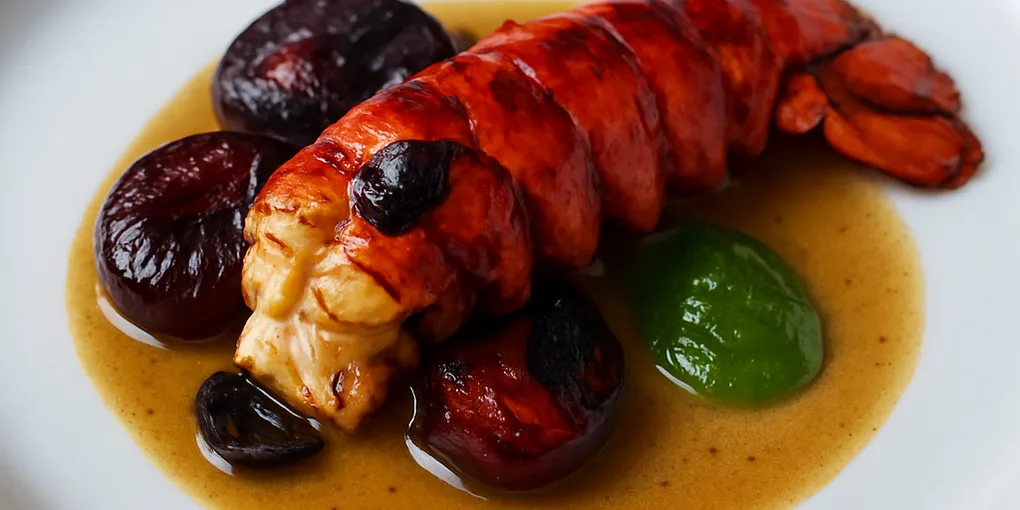
Smoked Plum & Black‑Garlic Lobster with Buckwheat Dashi‑Butter & Pickled Pine‑Needle Gel
Overview — why this dish is special
This is a celebration of contrasts: smoky, sweet plum smoke; deep, umami‑rich black garlic caramel; and an herbaceous, almost resinous pickled pine‑needle gel that cuts through richness. The secret twist is a two‑part technique—brief cold smoke of the lobster over roasted plum wood, followed by a fast pan‑char and glazing with black‑garlic‑reduced butter—which gives shellfish floral smoke and a roasted‑umami crust without drying the meat. Finished with a buckwheat dashi emulsified butter that adds toasted, nutty depth, this dish reads refined and surprising.
Taste profile (in one line)
Smoky and floral, sweet‑umami black garlic, nutty buckwheat, bright pine acidity — balanced richness with a crunchy buckwheat tuile.
Ingredients
Yields 2 generous portions.
For the lobster
- 2 lobster tails (8–10 oz / 230–280 g each), shell on, meat loosened from shell
- 40 g (3 tbsp) unsalted butter, divided
- 1 tsp fine sea salt
- 1 tbsp neutral oil (grapeseed or canola)
For the black‑garlic glaze (secret umami syrup)
- 80 g black garlic cloves (about 8–10 cloves)
- 60 ml (1/4 cup) dry vermouth or white wine
- 50 g honey
- 30 g soy sauce (or tamari)
- 15 g rice vinegar
For the buckwheat dashi‑butter
- 250 ml fish stock (preferably light bonito/kombu dashi)*
- 30 g toasted buckwheat groats (kasha)
- 120 g unsalted butter, cold and cubed
- Pinch of white pepper
- Salt to taste
*If you prefer vegetarian, use kombu + dried shiitake dashi.
For the pickled pine‑needle gel (secret herbaceous counterpoint)
- 50 g young pine needles, rinsed and finely chopped
- 150 ml rice vinegar
- 50 ml water
- 40 g sugar
- 2 g agar‑agar powder (or 3 g gelatin sheets, hydrated)
Crunch & garnish
- 40 g toasted buckwheat flour tuile (see method)
- Micro basil or shaved chives
- A few drops of smoked plum oil or high‑quality plum vinegar (optional)
- Charred plum wood ash (optional, for very light dusting)
Equipment
- Small smoker or smoking gun (or a disposable tin for cold smoke)
- Heavy skillet (cast iron preferred)
- Small saucepan, immersion blender or whisk
- Fine sieve and chinois
- Silicone spreader or offset spatula
- Siphon or small blender (optional for butter emulsion)
Mise en place (15–20 minutes)
- Loosen lobster meat from shells by sliding finger under meat; leave attached at base. Pat dry and season with salt.
- Toast buckwheat groats until fragrant and nutty, set aside.
- Peel black garlic and measure other glaze ingredients.
- Chop pine needles very fine.
Method — step by step
1. Make the black‑garlic glaze (can be done ahead)
- In a small saucepan, mash black garlic into a paste with a fork.
- Add vermouth and simmer gently until reduced by half.
- Stir in honey, soy sauce and rice vinegar. Simmer until syrupy — about 8–10 minutes on low. Strain through a fine sieve, pressing solids to extract flavor. Keep warm.
Why this matters: the black garlic’s roasted‑molasses notes amplify lobster’s sweetness without adding heat.
2. Prepare the buckwheat dashi‑butter
- Combine fish dashi and toasted buckwheat groats in a small saucepan. Simmer gently for 10 minutes to infuse.
- Strain and return warm liquid to the saucepan. Reduce slightly if necessary to concentrate flavor.
- Off heat, whisk in cold butter, a few cubes at a time, to form a glossy emulsion (or blitz with an immersion blender). Season with white pepper and salt to taste. Keep warm at about 50–60°C.
Texture note: the butter should be silky, not separated. If it looks thin, chill briefly and re‑emulsify.
3. Pickled pine‑needle gel (the aromatic counterpoint)
- Bring rice vinegar, water and sugar to a simmer. Add pine needles and steep off heat for 20 minutes.
- Reheat the mixture. If using agar, whisk in agar and boil 1–2 minutes. If using gelatin, dissolve hydrated gelatin into warmed mixture.
- Strain very fine. Pour into a shallow tray and chill until set — about 30 minutes. Once set, cut into small cubes or spoon into quenelles and keep chilled.
Flavor tip: the pine gives a resinous brightness that tastes almost citrus‑pine—impossibly clean against buttery lobster.
4. Toasted buckwheat tuile
- Mix 20 g buckwheat flour with 20 g water and a pinch of salt into a smooth paste.
- Heat a nonstick skillet over medium, brush a thin layer and cook until edges crisp. Transfer to rack to cool — it becomes a delicate, nutty crisp.
5. Cold‑smoke then sear the lobster (the secret smoke‑then‑sear technique)
- Preheat skillet over high.
- Place lobster tails in a shallow tray just large enough. Scatter a small handful of roasted plum wood chips (or dried plum stones) in the smoker chamber; generate cold smoke and infuse lids on lobster for 3–5 minutes — just enough to impart floral plum smoke without cooking.
- Heat skillet with 1 tbsp neutral oil until shimmering. Add 20 g butter.
- Sear lobster meat flesh‑side down 45–60 seconds to develop a quick crust. Flip and baste with the pan butter for another 30–45 seconds until just cooked through. Remove from pan and rest briefly.
Why this works: the cold smoke gives a delicate fruitwood aroma; the hot sear locks in juices and creates Maillard flavor that plays with the black‑garlic caramel.
6. Glaze and finish
- Return lobster to pan on low heat. Brush generously with the black‑garlic glaze and add a spoonful of buckwheat dashi‑butter. Let glaze reduce to a shiny lacquer — about 30 seconds per side.
- Remove and rest on warm plates.
Plating (deliver immediately)
- Spoon a pool of buckwheat dashi‑butter in the center of a warm plate.
- Place lobster tail halves, slightly fanned, over the butter.
- Dot with pickled pine‑needle gel cubes or quenelles around the lobster — they act like bright, herbaceous pearls.
- Lean a toasted buckwheat tuile against the lobster for crunch.
- Finish with micro basil, a very light dusting of charred plum wood ash (sparingly), and a couple of drops of smoked plum oil or plum vinegar to lift the flavors.
Make‑ahead & timing
- Black‑garlic glaze and buckwheat dashi‑butter can be made 2–3 days ahead and reheated gently.
- Pickled pine‑needle gel holds 3–4 days refrigerated.
- Smoking and searing the lobster should be done within 30 minutes of service for best texture.
Serving suggestions & wine pairing
- Serve with a dry, mineral white such as Chablis or a citrusy Grüner Veltliner to cut the butter.
- A lightly oaked Chardonnay also complements the glazed, smoky notes without overpowering the pine gel.
Final notes — the secret twist, summarized
- Two‑stage aroma technique: a brief cold smoke over roasted plum wood infuses perfume without cooking; an immediate high‑heat sear and black‑garlic glaze creates caramelized umami and a crisp surface. That combination gives lobster both floral smoke and deep roasted sweetness.
- Contrast elements: nutty buckwheat dashi‑butter for savory backbone, and pickled pine‑needle gel as a bright, resinous acid to cut richness. These contrasts are what elevate the dish from seafood plate to a memorable tasting‑menu moment.
Enjoy this theatrical, balanced plate that rewards careful technique with unforgettable depth.