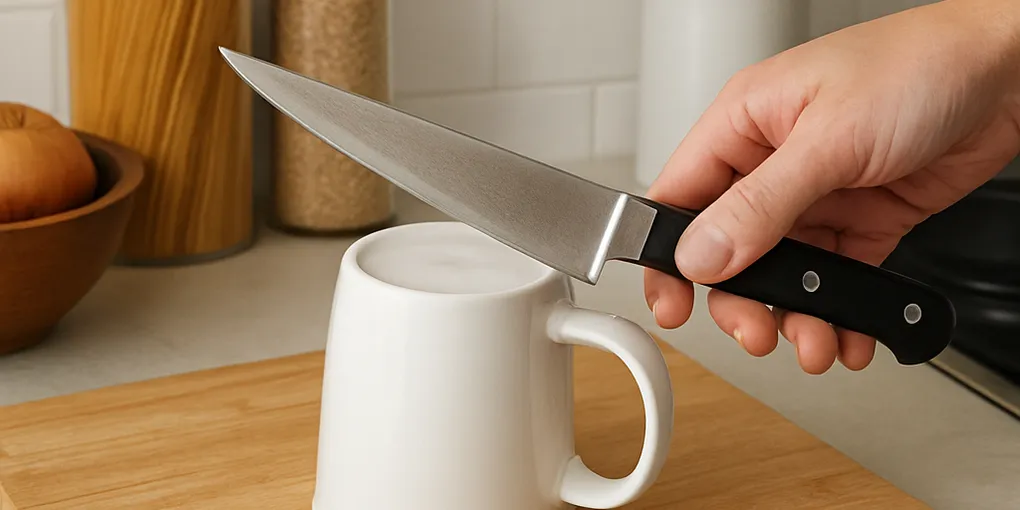
Hone a Dull Knife with a Ceramic Mug — Instant Edge Repair
Overview
A quick, reliable way to realign and freshen a kitchen knife’s edge without special tools: use the unglazed ring on the bottom of a ceramic mug as a makeshift honing surface. It’s not a substitute for sharpening, but it removes burrs and restores cutting performance in seconds.
Why this works
- The unglazed ceramic is hard and abrasive enough to realign the micro-edge on steel blades.
- Honing doesn’t remove much metal — it straightens and polishes the edge so the knife cuts cleanly again.
- Great for routine maintenance between full sharpenings.
You’ll need
- A ceramic mug with an unglazed ring on the bottom (check by feeling for roughness).
- A damp kitchen towel or non-slip mat.
- Your dull knife.
- Optional: a small towel to wipe the blade afterward.
Safety first
Before you begin
- Work on a stable surface.
- Point the blade away from your body and fingers at all times.
- Hold the mug firmly; keep fingers off the rim while honing.
Step-by-step instructions
1 — Set up
- Place the mug upside down on the damp towel or non-slip mat to prevent it from sliding.
- Stand so you have clear control of the knife and a comfortable angle.
2 — Position the knife
- Hold the knife by the handle with your dominant hand.
- Place the blade heel on the unglazed ring with the cutting edge angled downward at about 15–20 degrees to the ceramic.
3 — Hone in one direction
- Draw the blade away from you, sliding from heel to tip, maintaining the 15–20° angle.
- Move in a smooth motion so the entire edge glides across the ceramic.
- Repeat this motion 5 times.
4 — Switch sides
- Flip the knife so the other side of the edge meets the ceramic.
- Repeat the same 5 strokes from heel to tip.
5 — Test and repeat if needed
- Carefully test the edge on a piece of paper or a tomato skin.
- If still dull, do another 3–5 strokes per side.
- When satisfied, wipe the blade clean with a towel.
Troubleshooting
No effect?
- Confirm the mug has an unglazed ring — glazed surfaces are too smooth.
- If the blade is very nicked or blunt, this method won’t restore it — use a whetstone or professional sharpening.
Blade feels gritty
- Wipe the edge clean; tiny ceramic particles can adhere temporarily. Rinse and dry the blade if needed.
How often to use
- Hone with the mug every few uses or when cutting performance drops.
- Have knives professionally sharpened or use a proper whetstone once or twice a year, depending on use.
Quick maintenance tips
- Keep one designated mug for honing so you always know it has the right surface.
- Don’t use this method on serrated knives — they require specialized sharpening.
- For high-end or fragile blades (e.g., Japanese steels), prefer a proper honing rod or stone to avoid unintended abrasion.
Final note
This trick is fast, inexpensive, and perfect for daily upkeep. It won’t replace a sharpening stone for restoring a severely dull blade, but it will keep your knives slicing like new between full sharpenings.